
A Decade of Impact: The Access Books Bay Area Story

Updated: Jul 29
Tracing our journey from a local initiative to a trusted nonprofit reaching thousands of young readers

In the spring of 2016, middle school teacher-librarian Amanda Collins saw a problem. Located in an affluent neighborhood in Palo Alto, her students had the luxury of a well-maintained school library, serving as a sanctuary for book-lovers and an inviting space for all students to venture in. But only a few miles away in East Palo Alto, where the majority of students were living in poverty, books were seen as just that—a luxury. School libraries suffered the brunt of limited funding, their sparse shelves stocked with dated, worn-out paperbacks.
Growing up below the poverty line, Amanda had faced this disparity herself. “I know what it's like to not be able to buy books, to not be able to go to the public library because it's too far away, and if you don't return your books, your family can't afford to pay [the fines],” she recalls. As the only place she could access books, the school library became her “place.” “I read the entire 398.2 section of my elementary school library, folktales and fairy tales,” she laughs. “It was probably 150 books and I read all of them."
As a school librarian, Amanda worked hard to make the library the “place” for her own students, engaging with students and making sure the collection was up to date. Now, she wanted to do the same for those who grew up in underserved communities like her, starting with East Palo Alto.
When researching ways to help, Amanda learned about Access Books, a nonprofit working to bridge the literacy gap in underserved communities across Southern California. The organization carried out its mission by stocking school libraries with brand new books and revitalizing their spaces with colorful murals and comfortable sofas. Inspired by their work, she joined them for a project in South Central Los Angeles, before bringing their mission back to the Bay Area.
She started small, assembling a volunteer team of students and parents to refurbish the Costaño Elementary School library in East Palo Alto. Among them was Program Director and Board Secretary Alison Guan, who saw firsthand the impact Amanda’s flourishing school library had on her son, a self-proclaimed “library kid.” “I could see that going from elementary to middle school, a bigger environment, he'd found comfort in [Amanda’s] library,” she says. When she saw the condition of the library at Costaño, she realized her son was lucky to have such a welcoming space. “I could just see the disparity. There's a major haves-and-have-nots kind of contrast between the schools and facilities.”

The volunteer team at Costaño worked hard to process hundreds of new books for the school library in 2016.
Together, the team breathed new life into the Costaño library with over four hundred book donations, which they shelved and processed themselves. On Monday, students arrived at their school library to brand new, check-out ready books, vibrant murals painted on the walls, and a cozy seating area. Fueled by the project’s success, Amanda registered Access Books Bay Area as a nonprofit, inviting Alison and a fellow parent, Linda Forrester, to join the founding team. The rest is history.

Themed murals and comfortable new furniture transformed the Costaño school library into a welcoming hub for students.
Of course, the journey of starting and growing a nonprofit was not without challenges. As a new organization, one of the greatest hurdles the team faced was fundraising. Most grants favored organizations with paid employees, since it increased credibility. “We were stuck in this Catch-22 where we couldn't get the grant because we didn't have paid employees, but we couldn't pay employees because we couldn't get the grants,” explains Amanda. Most of the early funding came from friends and family.
Once the team was able to demonstrate impact, funding became easier, but new challenges emerged. Unfortunately, many of the schools where the need is highest cut funding for libraries completely—meaning if they received new books, there would be no staff to get them in the hands of students. Today, as we complete more and more refurbishments, the number of eligible schools that both serve impoverished communities and can afford a librarian grows slimmer. While this is a systemic issue, an important part of our mission is raising awareness on these disparities and advocating for the importance of school libraries.
Ten years after the first project at Costaño, Access Books Bay Area has grown in ways the founding team never imagined. We have 23 library refurbishments under our belt, and both the quality and quantity of books we donate has skyrocketed—from 470 used and new books at Costaño to over 1200 brand new books at our last refurbishment at Roosevelt Elementary. We have expanded our programs beyond school library refurbishments, installing Little Free Libraries across underserved communities in the Bay Area and holding free book fairs for unhoused families with our partners Amigos de Guadalupe.

With the help of a designated artistic director and larger volunteer teams, our murals have elevated in both scale and quality over the years.
Our programs have expanded to include Little Free Libraries and free book fairs for unhoused communities, so we can get books in the hands of students directly.
Our fundraising partners, including multi-year investments from the San Jose Sharks Foundation, the Campbell Foundation, and Google, have been instrumental in our continued growth. We have also formed partnerships with publishers including Chronicle Books and The Collective Book Studio, enabling us to receive brand new books for our programs. And the small but mighty founding team of three has expanded to over fifteen dedicated volunteers across fundraising, marketing, and the board.
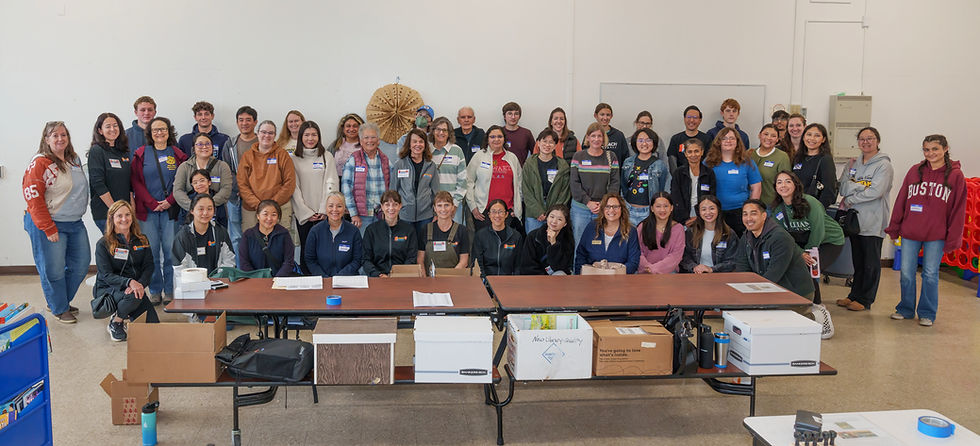
Our team has grown! Over forty people showed up to volunteer at Roosevelt Elementary School, including our long-term board and staff.
While much has changed over the last ten years, the organization’s core mission and commitment to quality remains the same. Our team members visit each school library to assess their collections, speak to the librarians, and sort through donations themselves. "We really take a lot of time with each school to see what they need and what would be best for their community [to] really augment their collection in meaningful ways,” notes Amanda. We also continue to center our work around uplifting school libraries, as they allow us to get books into the hands of thousands of children on an ongoing basis.
"I didn't have any idea that ten years later I would still be doing it, and that we would have impacted so many children in a positive way,” reflects Alison. Amanda shares a similar sentiment. “I feel really gratified,” she says. “Bringing together all these people and making this awesome thing happen for a community I think is really special. That was what I wanted to do in the first place, right?”
As we continue to expand our programs and reach, one thing is certain: We won’t lose sight of where we started. Access Books Bay Area was born from a middle school librarian’s desire to serve and unite her local community, and keeping that spirit alive is how we stay true to our mission, no matter what comes our way.
Related Reading:
How We Select Books for Refurbishments:
California’s School Library Crisis: